
Simplify the Belt Conveyor Maintenance with 5 Essential implementations.
Introduction
These 5 implementations are definitely suitable for your conveyor maintenance. These implementations reduce maintenance time and work difficulties. The implementations are suitable for all belt conveyors. We implemented these solutions at our site, and the results were very satisfactory. These implementations also improved our employees’ morale. Here, I am explaining 5 implementations, 4 of which were fabricated in-house by our own people. This methods are horizontal deployment for Raw material handling belt conveyors.
1. Online roller replacement arrangement
In raw material charging conveyor, damaged rollers are replaced by switching off the conveyor and need to lift the belt by using steel rod with manual load for replacing the damaged rollers.
Requirements for roller replacement :
- Three manpower is required
- Need to wait for getting conveyor clearance
- Conveyor need to be stopped
- Production getting affected
- Heavy man load
- More than 10 minutes required to replace the roller
Action:
Conveyor lifting arrangement with roller, turn buckle and tie rod lock screw are fabricated with in house materials. By using this arrangement, we can able to lift the conveyor without stopping and can replace the rollers.
Online roller replacement video
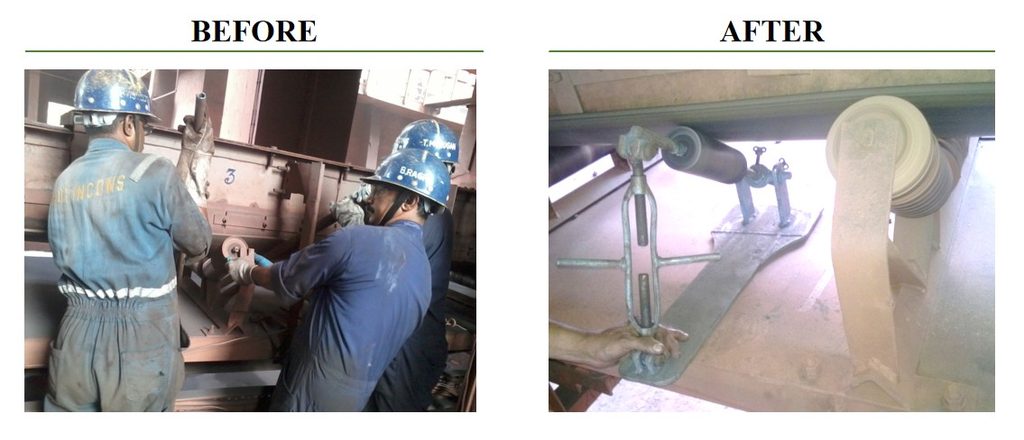
Due to this modification we have achieved:
- One manpower is enough for roller replacement
- No need to wait for conveyor clearance
- No need to stop the conveyor (can do online)
- Production not get affected
- Only 2 minutes is enough to replace roller
Also read: These Improvements Can Reduce Your Hydraulic Maintenance Burden in Industries
2. Lever arrangement for Roller replacement.
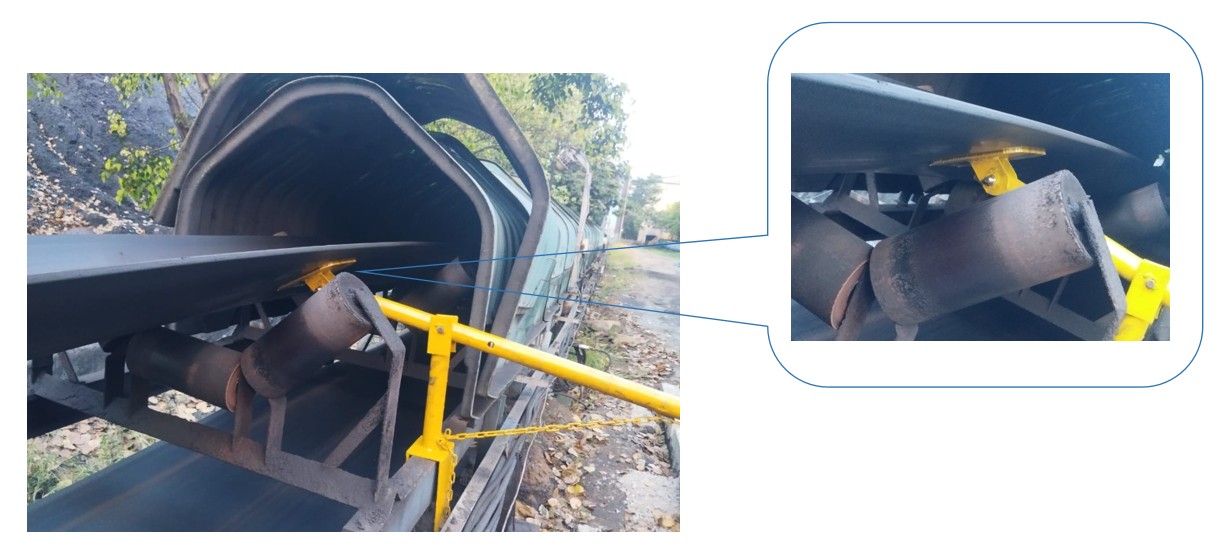
This method is possible only when the conveyor is offline. If you fix this lever arrangement between two stands, you can easily change the rollers of two stands. Both side rollers (2 nos.) and the bottom roller (1 no.) can be changed.
Initially roller replaced manually by using steel bar. For that requirements already explained above topic.
This lever’s vertical support can be fixed to the conveyor carrying frame without bolts, nuts, or welding. After pushing the horizontal pipe, you can lock the chain. Meanwhile, a gap is created between the roller and the belt, allowing you to change the roller easily.
Benefits:
- Roller replacement time was reduced.
- Unsafe condition was eliminated
- Employee morale improved
3. Skirt Rubber hole cutting machine
In belt conveyors, skirt rubber is fitted on both sides of conveyor at material charging areas to prevent material spillages. The skirt rubber is bolted on its hole with skirt board. The hole in the skirt rubber was made by using a hot steel rod having sharp end. The hole making process required minimum two manpower and consumed more time. And also gases (O2 & LPG) were consumed to heat the steel rod.
We decided to develop the cutting system consists of cutting tool, holding bush, screw rod with handle, teflon pad and stand. The above parts were fabricated from In-house material and finally the Skirt rubber cutting machine was introduced. Various cutting tools to make different sizes and shapes (hole, slot etc..) were fabricated.
By using this Skirt rubber cutting machine holes or slots can be made easily in the skirt rubber with minimum time and energy.
Skirt rubber hole cutting machine working video
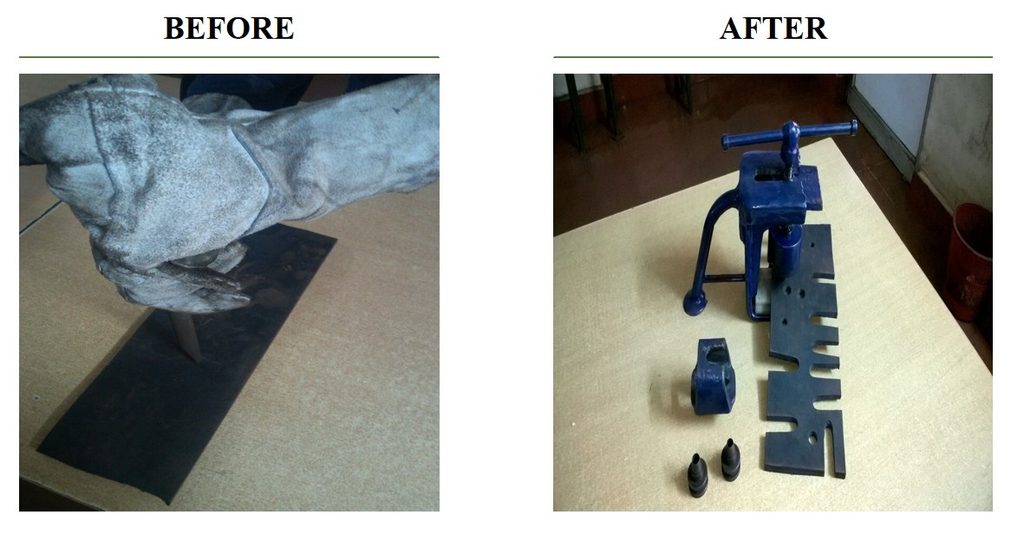
BENEFITS:
- Manpower requirement is reduced from two to one
- Hole/Slot making time is reduced from 5 mins to 1min per number
- Cutting gases consumption (LPG & O2) is eliminated for skirt rubber cutting
4. Quick flex couplings in place of geared couplings in RMHS conveyors.
We used gear couplings for all RMHS conveyors, which required high maintenance. Lubrication was required every month, and inspection of the gear teeth in the hub and cover had to be carried out once every three months. Coupling replacement also disturbed the alignment.
After introducing quick flex couplings, lubrication and inspection are no longer required, making them maintenance-free. There is no need to replace the entire coupling; only the elastomer/insert needs to be replaced. Replacing the elastomer takes only 3 minutes, and the alignment will not be disturbed. You won’t need large inventories of spare parts for couplings the only part you’ll need is a poly urethane spyder rubber insert that can be replaced in just a few minutes without removing the hubs. There’s no metal-to-metal contact of Quick-Flex couplings, so you’ll save money by avoiding damage to hubs or other metal components.
The approximate annual lubrication cost, including manpower, is ₹3,500 per gear coupling. By modifying 17 couplings, the total annual cost saving is ₹59,500.
5. V scrapper for conveyor take-up pulley
Most industries do not have a V-scraper arrangement for the conveyor take-up pulley. However, we provided this arrangement in our coke handling conveyors because any coke pieces falling onto the take-up pulley due to belt sway can damage the pulley lagging and conveyor belt. After this implementation the pulley lagging life was improved.
The scraper was fabricated in-house using a Teflon sheet and installed in an inverted position. If any coke pieces or other materials fell onto the scraper, they were directed away from the pulley.
Also read:
Wrench Time Analysis: How We Reduce Stamping Hammer Lifting Time from 45 to 21 Minutes
Can 75 meter tall steel chimney structures be dismantled without having a path for access?
One Comment