

Pentagon Big Tech Tesla Cybertruck : Here’s What’s Actually Happening
Pentagon Big Tech Tesla Cybertruck: What Is Happening? Short answer: the U.S. Air Force Test Centre wants two Tesla Cybertrucks. Not to deploy them. To blow them up. They’re part of a 33-vehicle order of “towable target vehicles” headed to White Sands Missile Range in New Mexico. The buy supports…
Pentagon Big Tech Tesla Cybertruck: What Is Happening?
Short answer: the U.S. Air Force Test Centre wants two Tesla Cybertrucks. Not to deploy them. To blow them up.
They’re part of a 33-vehicle order of “towable target vehicles” headed to White Sands Missile Range in New Mexico. The buy supports U.S. Special Operations Command’s Standoff Precision Guided Munitions (SOPGM) program.
That’s the whole story. No secret armoured fleet. No combat deployment. No confirmed multi-hundred-million-dollar Tesla defence contract. The trucks don’t even need to run. Contracting documents say they just need to be towable, with the batteries pulled before testing.
Table of Contents
Why the Air Force singled out the Cybertruck by name
Of the 33 target vehicles on the list, sedans, small “bongo” trucks, pickups, SUVs, the Cybertruck is the only one called out by make and model. Everything else on the list was requested generically.
The paperwork gives two main reasons.
- The unpainted stainless-steel exoskeleton behaves differently under impact than the painted steel or aluminium bodies on a typical sedan or pickup. And the blocky, angular shape makes it easy for pilots and weapons officers to spot visually during high-speed targeting runs.
- The Air Force also flagged something else: it thinks vehicles like the Cybertruck could show up on real battlefields. Maybe because adversaries favour durable, distinctive commercial vehicles. That’s the theory, anyway.
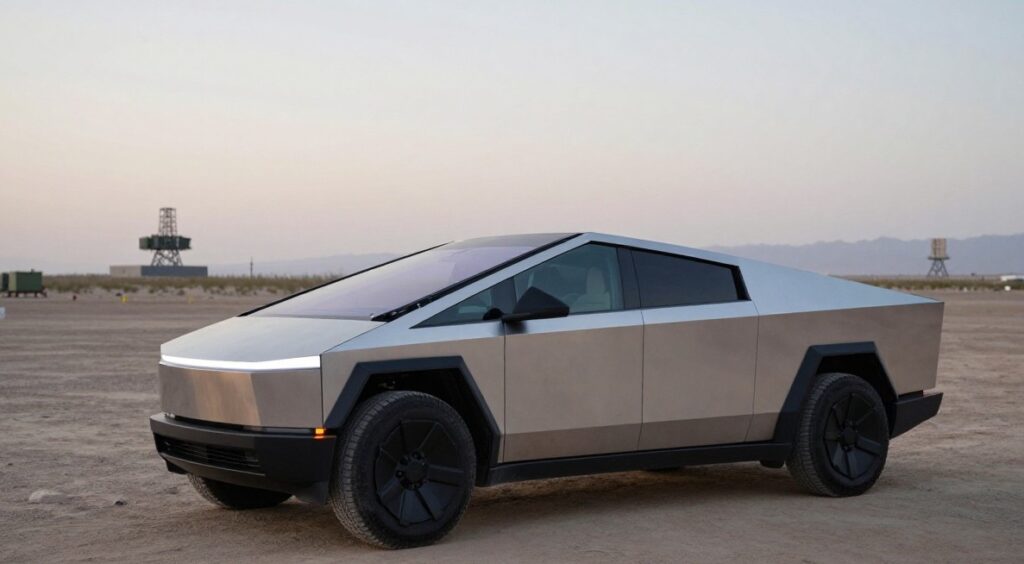
The military wants real data on how its munitions perform against this specific vehicle type before it might run into one for real. Tesla didn’t pitch the Pentagon on a defence deal. The Pentagon just wants a target that matches what it thinks it might actually face.
The SOPGM program: the part most headlines skip
SOPGM stands for Standoff Precision Guided Munitions. It’s a Special Operations Command program covering several air-launched, precision-guided weapons:
| Munition | Type |
| AGM-114 Hellfire | Air-to-surface missile |
| AGM-176 Griffin | Lightweight guided missile |
| GBU-69/B Small Glide Munition | Precision glide bomb |
| GBU-39B/B Laser Small Diameter Bomb | Laser-guided bomb |
The U.S. government’s official procurement database provides public records of Department of Defense contracts and procurement activity. USAspending.gov — Department of Defense contract records
These weapons need realistic targets to prove they work. That’s why the Air Force regularly buys ordinary civilian-style vehicles to destroy under controlled conditions at White Sands. This time, two of those vehicles happen to be Cybertrucks. SOPGM is a Special Operations Command program that tests precision-guided munitions like the Hellfire missile against realistic target vehicles. That’s the reason the Air Force is buying Cybertrucks for destructive testing.
Hummer EV Torque Explained: What 11,500 lb-ft Actually Means
Separating fact from fiction: common myths about this story
“Pentagon” and “Tesla” in the same sentence makes for a good headline. A lot of low-quality content has run with that and stretched the facts. Here’s what to watch for.
Myth 1: the Pentagon is militarizing the Cybertruck. No confirmed program adds weapons, armour, or military electronics to the vehicle. The only verified interest is destructive testing. Not fleet adoption.
Myth 2: Big Tech is redesigning the Cybertruck for defence. There’s no documented partnership where NVIDIA, Google, Microsoft, or Amazon are modifying the truck itself. Those companies do have real Pentagon contracts (cloud computing, AI infrastructure, satellite communications). Mixing that up with Cybertruck development is just wrong.
Myth 3: there’s a $400 million Cybertruck deal. That figure comes from a separate rumor: a proposed State Department purchase of armoured Cybertrucks for diplomatic security. It drew public scrutiny and reportedly got dropped from procurement listings. It never became a completed contract, and it has nothing to do with the Air Force’s target-vehicle order.
Myth 4: this proves Tesla’s bulletproof marketing claims. Tesla has talked up the Cybertruck’s resistance to small-arms fire, mostly around the side panels. Owners report mixed results in the real world. The Air Force is testing it precisely because it wants independent, verified data, not because it’s confirming Tesla’s ad copy.
Key takeaways
The “Pentagon Big Tech Tesla Cybertruck” story comes down to one verifiable fact: the Air Force wants two Cybertrucks as missile-test targets at White Sands, as part of a 33-vehicle order for the SOPGM program.
It’s not a military adoption program. It’s not a Big Tech co-design effort. It doesn’t confirm Tesla’s durability marketing either.
The trend that actually matters here is bigger: the Pentagon leaning harder on commercial tech companies, cloud providers, AI firms, satellite networks, to modernize its capabilities. That’s worth following closely. The Cybertruck headline is just the loudest, clickiest data point sitting inside it.
Buying a Used Tesla for Sale? Check This Before You Pay
Insurance on a Tesla Model 3: What It Actually Costs in 2026
Tesla Models 2026: Every Car You Can Actually Buy Right Now
Is the Pentagon buying Tesla Cybertrucks for military use?
No. The Air Force is acquiring two Cybertrucks as non-functional target vehicles for missile testing at White Sands. Not for combat. Not for fleet deployment.
Why did the Air Force pick the Cybertruck instead of a normal truck?
Its unpainted stainless-steel body and angular shape create a different damage profile than typical painted-steel vehicles. Testers want realistic data in case similar vehicles show up on future battlefields.
What is White Sands Missile Range used for?
It’s a U.S. Army-operated testing site in New Mexico used for live-fire testing of missiles and guided munitions, including the Air Force’s SOPGM program.
Are Big Tech companies helping build a military version of the Cybertruck?
No verified program modifies the Cybertruck for military use. Big Tech companies do have separate Pentagon contracts in cloud computing, AI, and satellite communications, but that’s a different story entirely.
What happened to the $400 million Cybertruck deal rumor?
That number was tied to a proposed State Department purchase of armoured Cybertrucks for diplomatic security. It drew criticism and reportedly got pulled from procurement plans. It’s unrelated to the Air Force’s target-vehicle testing.



One Comment