
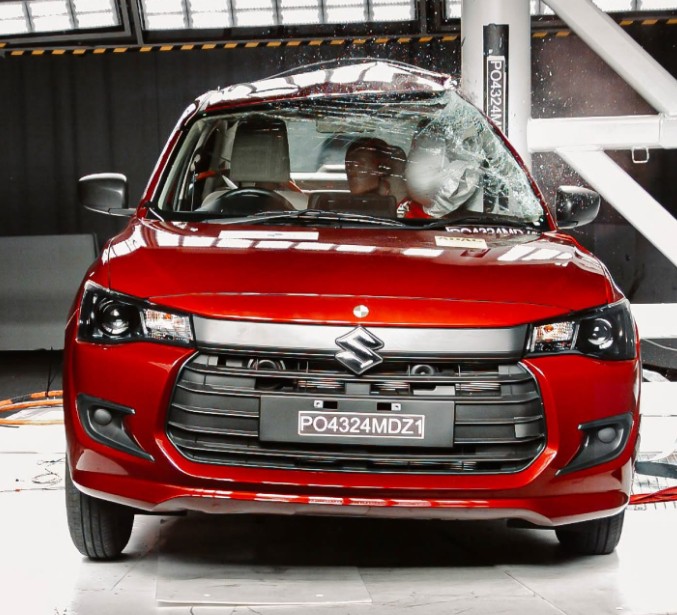
Maruti Dzire 5 Star Safety Rating: What Does It Really Mean?
The news that the Maruti Suzuki Dzire received a Global NCAP 5-Star Safety Rating attracted a lot of attention in the Indian car market. The fact that a Maruti Suzuki car from the budget segment received a 5-Star Adult Occupant Protection Rating came as a surprise to many people. After this, memes also appeared on social media under the name of the “5-Star car.” A photograph of a Dzire’s door damaged in a minor accident was used to mock the rating, with people asking, “Is this what a 5-Star rating means?”
But that view is not complete. If a car receives a 5-Star Rating, it does not mean that it will protect its occupants 100% in every accident. Only by understanding how the rating is given, what its limitations are, and what should be checked when buying a car can you make the right decision.
A 5-Star Rating Is Not 100% Safety
Star Rating Is the Result of a Laboratory Test
An NCAP Rating is given based on the results of a crash test conducted under specific conditions. The test evaluates the car’s structure, the risk of injuries to the dummies, the seat-belt system, airbags and certain safety features.
In a real accident, factors such as speed, the type of object involved in the collision, the angle of impact, the number of people in the car and seat-belt usage can change the outcome. Therefore, a 5-Star Rating means that “the car performed well under these testing conditions.”
Is the Rating Alone Enough?
When choosing a car, the Star Rating should be an important factor. But you should not make a decision based on it alone. Adult and Child Occupant Protection scores, the tested variant, the number of airbags, Electronic Stability Control, ISOFIX and passenger cabin integrity should also be checked.
The car’s maintenance, tyre condition, braking performance and the driver’s habits also play a major role in safety. If a safe car is driven at high speed or carelessly, the risk of an accident will not be reduced.
How Does Global NCAP Give a Star Rating?
The Beginning of Crash-Test Assessment
The National Highway Traffic Safety Administration of the United States started a crash-testing programme in 1979. Initially, only the technical values and injury readings obtained during the tests were published. To make these results easier for ordinary car buyers to understand, they were later converted into a points and Star Rating system. A higher Star Rating means that the car provided better occupant protection within those testing rules.
Global NCAP, Euro NCAP and Bharat NCAP
Global NCAP, Euro NCAP, ASEAN NCAP and Bharat NCAP are different New Car Assessment Programmes. Their test speeds, protocols, scoring methods and safety criteria may be different.
Global NCAP is not a mandatory government approval test. It is a voluntary assessment programme. Car manufacturers can send their models for testing. In some cases, the organisation itself may select popular-selling models for testing.
Bharat NCAP is a voluntary programme operated under the Government of India. Although it is based on Global NCAP, its scoring structure and test rules are separate.
Changes Brought by NCAP Tests in India
Results of Early Budget Cars
When Global NCAP tests started receiving attention in India, the low scores of several popular budget cars came to light. Models such as Tata Nano, Maruti Suzuki Alto, Hyundai i10, Ford Figo, Maruti Suzuki Swift and Datsun Go received low or zero ratings.
During the same period, airbags were not standard features in many cars and were offered like optional accessories. The airbag-equipped version of the Volkswagen Polo received a comparatively better result in that list.
Consumer Questions Brought Changes
After these results were released, car buyers started asking questions such as, “Does it have an airbag?” and “How safe is the car?” This made car manufacturers pay more attention to safety features, seat-belt reminders and crash performance.
The government’s Automotive Industry Standards include basic requirements such as seat-belt warnings, airbags and reverse parking sensors. But meeting government regulations and getting a 5-Star NCAP rating are not the same thing. Government rules ensure basic protection, while NCAP measures additional crash protection.
What Do the Maruti Suzuki Dzire’s 5-Star Scores Tell Us?
5-Star Adult Occupant Protection
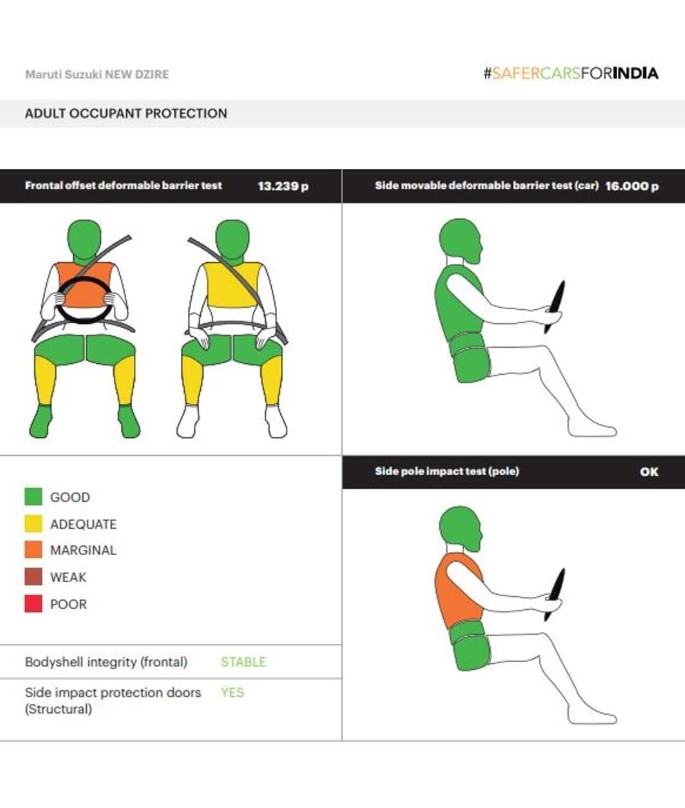
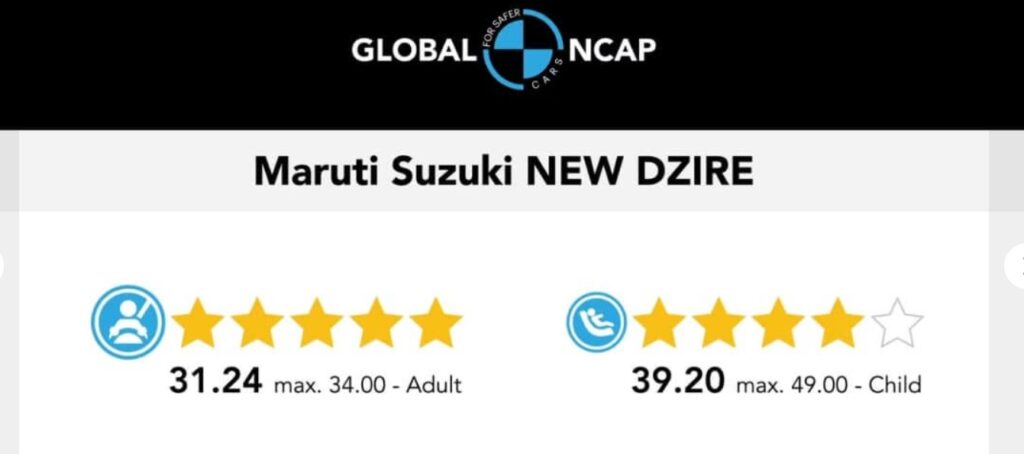
According to the Global NCAP fact sheet, the new Maruti Suzuki Dzire received a 5-Star Rating in Adult Occupant Protection. Out of a maximum of 34 points, the Dzire scored 31.24 points. This rating includes aspects such as frontal crash protection, side impact, restraint performance and the stability of the passenger compartment. Even if the front of the car is damaged, what matters is how well the cabin where the occupants are seated remains protected.
4-Star Child Occupant Protection
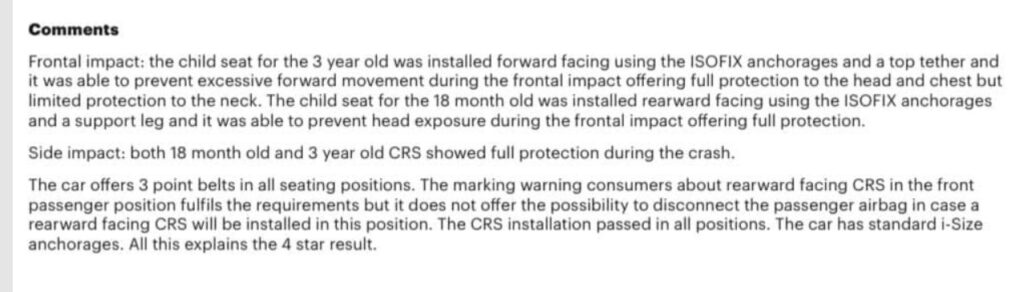
In the Child Occupant Protection category, the Dzire scored 39.20 points out of a maximum of 49 points. Based on this, it received a 4-Star Rating for child safety. This clearly shows that the Adult Rating and Child Rating do not have to be the same. Child restraint systems, child-seat compatibility and dummy readings are evaluated separately. The points allocation in Global NCAP and Bharat NCAP score sheets may differ. Therefore, instead of directly comparing the scores of the two organisations, their respective methodologies should also be considered.
How Are Crash Tests Conducted on Cars Like the Dzire?
Frontal Offset Deformable Barrier Test
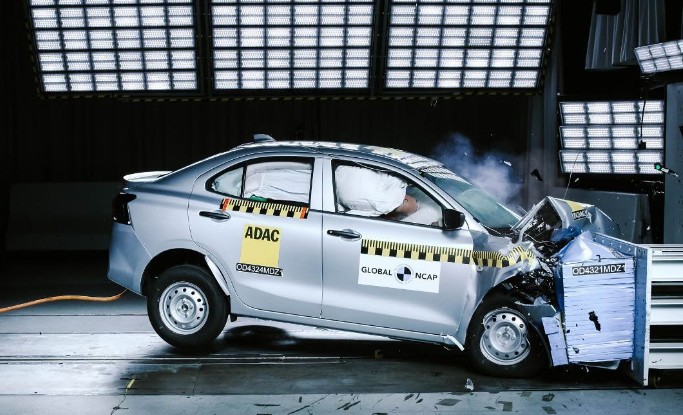
In this test, only a portion of the front of the car hits a deformable barrier. According to the Global NCAP protocol, this test is conducted at a speed of 64 km/h. The impact on the dummy’s head, neck, chest and legs is measured. If the front section deforms in a controlled manner while the cabin remains stable, occupant protection is rated better.
Side Impact and Side Pole Test
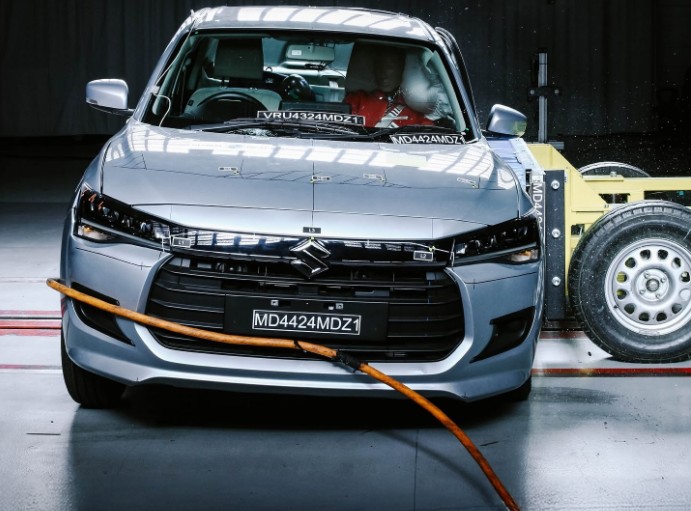
In the Side Movable Deformable Barrier Test, a moving barrier hits the side of the car. Door intrusion, side structure, seat belt and the injury risk to the dummy’s chest, abdomen and head are examined. This test is generally conducted at a speed of 50 km/h.
In the Side Pole Impact Test, the car hits a narrow and rigid pole from the side. This test is conducted at 29 km/h. Side airbags, curtain airbags, door reinforcement and passenger cell integrity are important here. These speeds are not a guarantee of what will happen in a real-world crash. They are standardised laboratory conditions used to obtain comparable results.
Why Does a 5-Star Car Get Damaged in an Accident?
Crumple Zones Reduce Impact Energy
The idea that “the car has been badly damaged, so it is unsafe” can be wrong. Crumple zones are deliberately designed into the front and rear sections of a car. During an accident, these areas deform in a controlled manner. This allows a portion of the crash energy to be absorbed by the car itself. If all that energy reaches the passenger cabin, the severity of injuries to the occupants can increase.
The Passenger Cell Is Important
Damage to the engine bay or boot does not mean that the passenger cabin has also collapsed. If the A-pillar, B-pillar, roof, floor and door structure remain safe, the area where the occupants are seated can provide better protection. Even if a crash video shows extensive external damage to the car, low dummy readings and controlled cabin deformation can indicate good crash performance.
It is also not correct to compare the safety of Tata and Maruti Suzuki cars based on real-world accident photographs alone. Crash speed, vehicle weight, angle, the height of the object involved and braking can change the damage.
How to Buy a Car by Understanding the Limitations of Global NCAP Ratings?
Remember the Crash-Test Speed
The 64 km/h frontal offset crash, 50 km/h side movable barrier crash and 29 km/h side pole crash are conducted under specific test conditions. The energy involved in a collision at 80 or 100 km/h will be higher than this.
No 5-Star Rating can guarantee complete protection at all speeds, from all angles or in every type of collision. Therefore, the rating should be considered along with safe driving habits. Even if two cars have the same Star Rating, they should not be directly compared if the model year, tested equipment and test protocol are different.
Conclusion
The Maruti Suzuki Dzire’s Global NCAP 5-Star Adult Occupant Protection Rating is an important improvement in the safety of the car. At the same time, it should also be noted that it received only a 4-Star Rating in Child Occupant Protection.
A 5-Star Rating does not mean that the car is 100% accident-proof. Damage to the front of the car during a crash can be part of the design that allows crumple zones to absorb impact energy. Passenger cabin integrity, dummy injury readings, airbags and restraint systems are more important than external damage when it comes to safety.
When buying a car, use the Star Rating as the first filter. After that, check the tested variant, safety features, maintenance cost, tyres and your driving habits before making a decision. A safe car can help during an accident; seat belts, controlled speed and responsible driving are what complete that safety.
More:
Used Car Buying Guide 2026: Spinny vs Cars24 vs Local Dealers Compared

One Comment