
Mohan Sundar / EV & Engineering
What Is an Electric Scooter?
An electric scooter is a two-wheeled vehicle powered by an electric motor instead of an internal combustion engine. Energy is stored in a rechargeable battery pack and supplied to the motor through an electronic controller.
When the rider twists the throttle, the controller regulates power from the battery and sends it to the motor, which rotates the wheel and moves the scooter forward.
Key Features
- Battery-powered vehicle
- Zero tailpipe emissions
- Quiet operation
- Low maintenance
- Instant torque delivery
Regenerative braking in some models
Regenerative braking in some models
Basic Working Principle of an Electric Scooter
The operation of an electric scooter is relatively simple compared to a petrol scooter. Electrical energy stored in the battery is converted into mechanical energy by the electric motor.
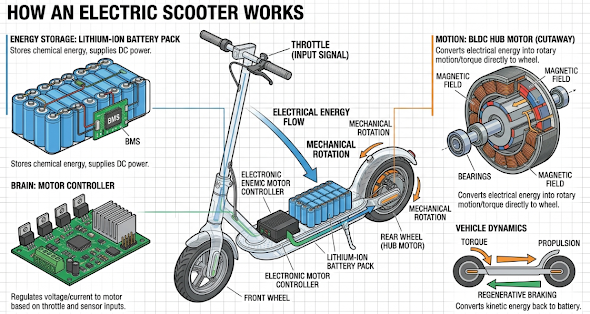
Simple Power Flow
Battery → Controller → Motor → Wheel Movement
When the rider accelerates:
- Battery supplies DC power
- Controller regulates power flow
- Motor converts electricity into rotation
Wheel rotates and propels the scooter
Main Components of an Electric Scooter
Several components work together to ensure smooth and efficient operation.
1. Battery Pack
The battery is the energy storage unit of the scooter. Most modern electric scooters use lithium-ion batteries because they offer high energy density, long life, and fast charging capability.
Functions
- Stores electrical energy
- Supplies power to the motor
- Determines scooter range
Supports charging and discharging cycles
Supports charging and discharging cycles
Common Battery Types
- Lithium-Ion (Li-ion)
- Lithium Iron Phosphate (LFP)
Nickel Manganese Cobalt (NMC)
Nickel Manganese Cobalt (NMC)
2. Battery Management System (BMS)
The Battery Management System is the brain of the battery pack. It continuously monitors battery health and protects it from unsafe operating conditions.
Functions
- Overcharge protection
- Over-discharge protection
- Temperature monitoring
- Cell balancing
- Short-circuit protection
State of Charge (SOC) calculation
State of Charge (SOC) calculation
Without a BMS, battery life and safety would be significantly reduced.
3. Motor
The electric motor converts electrical energy into mechanical energy. Most electric scooters use either a BLDC (Brushless DC) motor or a PMSM (Permanent Magnet Synchronous Motor).
Functions
- Generates wheel rotation
- Provides acceleration
- Produces driving torque
Converts electricity into motion
Converts electricity into motion
Motor Locations
Hub motor (inside wheel)
Mid-drive motor (mounted centrally)
Hub motor (inside wheel)
Mid-drive motor (mounted centrally)
4. Motor Controller
The controller acts as the central command unit of the scooter. It receives signals from the throttle and adjusts the amount of power delivered to the motor.
Functions
Controls motor speed
Regulates torque output
Improves efficiency
Manages regenerative braking
Protects motor and battery
Controls motor speed
Regulates torque output
Improves efficiency
Manages regenerative braking
Protects motor and battery
The controller is often referred to as the “brain” of the drivetrain.
5. Throttle
The throttle is the rider’s interface for controlling speed. Twisting the throttle sends a signal to the controller, which increases motor power accordingly.
Functions
Controls acceleration
Sends rider input to controller
Adjusts motor speed
Controls acceleration
Sends rider input to controller
Adjusts motor speed
6. Charger
The charger converts AC power from the electrical grid into DC power suitable for charging the battery.
Functions
Charges battery safely
Controls charging voltage
Prevents overcharging
Charges battery safely
Controls charging voltage
Prevents overcharging
Charging times typically range from 3 to 8 hours depending on battery size.
7. Regenerative Braking System
Some electric scooters use regenerative braking to recover energy during deceleration.
How It Works
When braking:
Motor acts as a generator
Kinetic energy converts into electrical energy
Energy is sent back to battery
Improves overall efficiency
Benefits
Increased driving range
Reduced brake wear
Better energy utilization
Increased driving range
Reduced brake wear
Better energy utilization
Step-by-Step Working of an Electric Scooter
Let’s understand the complete operation from startup to movement.
Step 1: Power On
When the scooter is switched on:
Battery activates
Controller performs system checks
BMS verifies battery status
Display turns on
The scooter is now ready to ride.
Step 2: Throttle Input
The rider twists the throttle.
The throttle sends an electronic signal to the controller indicating the desired speed.
Step 3: Controller Processes Command
The controller calculates:
Required speed
Required torque
Available battery power
Motor operating conditions
It then sends the appropriate electrical current to the motor.
Step 4: Motor Produces Torque
The motor converts electrical energy into rotational force.
This torque rotates the wheel and moves the scooter forward.
Step 5: Continuous Monitoring
While riding:
BMS monitors battery temperature
Controller monitors motor performance
Sensors track speed and power consumption
Safety systems remain active
Step 6: Braking
When brakes are applied:
Motor power reduces
Mechanical brakes engage
Regenerative braking may recover energy
The scooter slows down safely.
Why EVs Produce Instant Torque Compared to Petrol Cars
Hub Motor vs Mid-Drive Motor
Electric scooters generally use one of two motor configurations.
| Feature | Hub Motor | Mid-Drive Motor |
|---|---|---|
| Location | Inside wheel | Center of scooter |
| Cost | Lower | Higher |
| Maintenance | Low | Moderate |
| Efficiency | Good | Excellent |
| Performance | Good | Better torque |
| Weight Distribution | Average | Better |
Hub motors are more common in electric scooters because of their simplicity and lower cost.
Advantages of Electric Scooters
Electric scooters offer several benefits compared to conventional petrol scooters.
Advantages
Zero emissions
Lower operating cost
Quiet operation
Instant acceleration
Fewer moving parts
Reduced maintenance
Home charging convenience
Higher energy efficiency
Zero emissions
Lower operating cost
Quiet operation
Instant acceleration
Fewer moving parts
Reduced maintenance
Home charging convenience
Higher energy efficiency
Disadvantages of Electric Scooters
Despite their benefits, electric scooters also have some limitations.
Disadvantages
Higher initial purchase cost
Limited charging infrastructure in some areas
Battery degradation over time
Reduced range in extreme temperatures
Charging time required
Battery replacement cost
Higher initial purchase cost
Limited charging infrastructure in some areas
Battery degradation over time
Reduced range in extreme temperatures
Charging time required
Battery replacement cost
Future developments include:
Solid-state batteries
Faster charging systems
Longer driving ranges
AI-based energy management
Advanced regenerative braking
Vehicle-to-grid (V2G) capability
Improved safety systems
Solid-state batteries
Faster charging systems
Longer driving ranges
AI-based energy management
Advanced regenerative braking
Vehicle-to-grid (V2G) capability
Improved safety systems
As battery costs continue to decline, electric scooters are expected to become even more affordable and popular worldwide.
Conclusion
Electric scooters work by converting electrical energy stored in a battery into mechanical energy through an electric motor. Components such as the battery pack, BMS, controller, motor, throttle, and regenerative braking system work together to provide smooth, efficient, and eco-friendly transportation. With lower running costs, minimal maintenance, and continuous technological improvements, electric scooters are becoming a key part of the future of urban mobility