Tesla Battery Replacement Cost in 2026: The Shocking Truth Behind the $25,000 Number
If you own a Tesla, or you’re eyeing a used one, you’ve probably typed “Tesla battery replacement cost” into Google at least once. Most Tesla owners never pay for a battery replacement out of pocket. The pack is covered by an 8-year warranty, and in practice it tends to outlast…
If you own a Tesla, or you’re eyeing a used one, you’ve probably typed “Tesla battery replacement cost” into Google at least once. Most Tesla owners never pay for a battery replacement out of pocket. The pack is covered by an 8-year warranty, and in practice it tends to outlast that warranty by a wide margin. But when a replacement does happen outside that window, the bill is real: anywhere from $8,000 to $25,000+ in the US, and roughly £8,000 to £20,000 in the UK and Europe, depending on the model and battery size.
Table of Contents
Tesla battery replacement cost by model (US pricing)
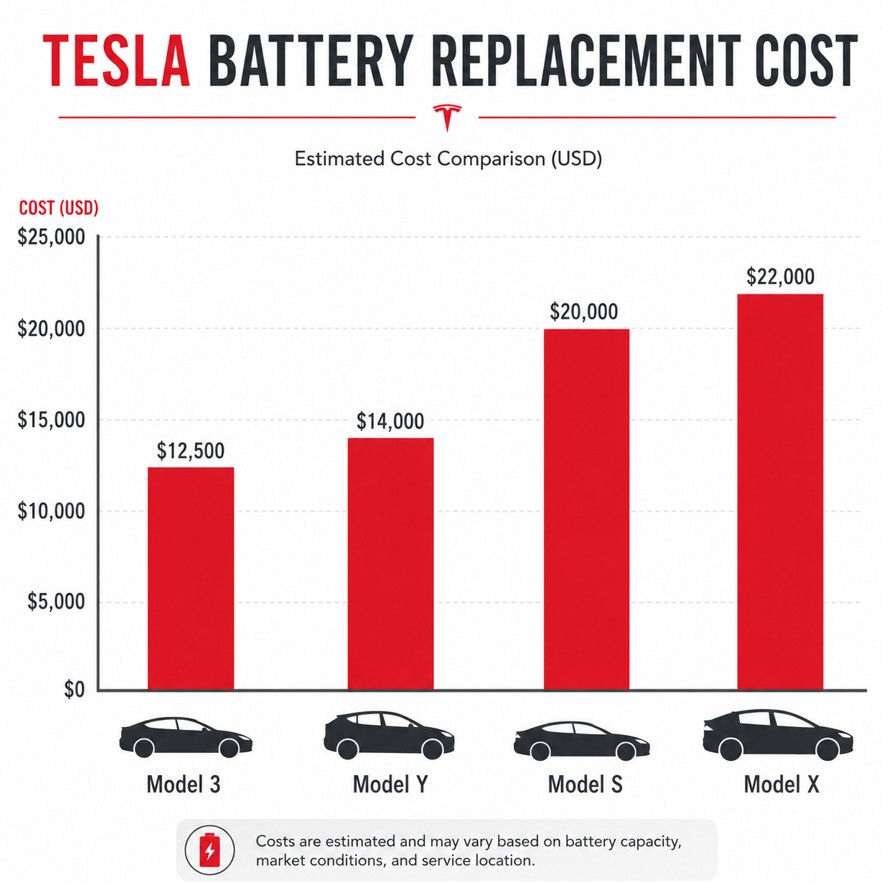
Cost scales pretty predictably with pack size (measured in kWh) and vehicle weight. A Model 3 Standard Range battery is smaller and cheaper to swap than a Model X or Model S pack.
| Model | Battery Size | Estimated Out-of-Warranty Cost (US) |
| Model 3 Standard Range | 50 kWh | $8,000 – $12,000 |
| Model 3 Long Range/Performance | 75 – 82 kWh | $12,000 – $16,500 |
| Model Y | 75 – 82 kWh | $10,000 – $18,000 |
| Model S | 100 kWh | $13,000 – $20,000 |
| Model X | 100 kWh | $15,000 – $22,000+ |
These numbers include the pack itself plus labor, which usually adds $1,000 to $3,000 depending on the job. A clean swap might take 3 to 5 hours. A repair involving corrosion or crash damage takes a lot longer.
Refurbished or remanufactured packs from independent EV specialists can knock 30 to 50% off that price, often landing between $6,500 and $17,500 depending on the model. The catch: a shorter warranty on the replacement pack, usually 1 to 3 years instead of Tesla’s original coverage.
How much does it cost to replace a Tesla battery?
Between $8,000 and $25,000 in the US, depending on the model. Model 3 packs are the cheapest to replace, around $8,000 to $16,500. Model S and Model X run higher, $13,000 to $22,000+, because of their larger capacity.
Tesla battery replacement cost in Europe
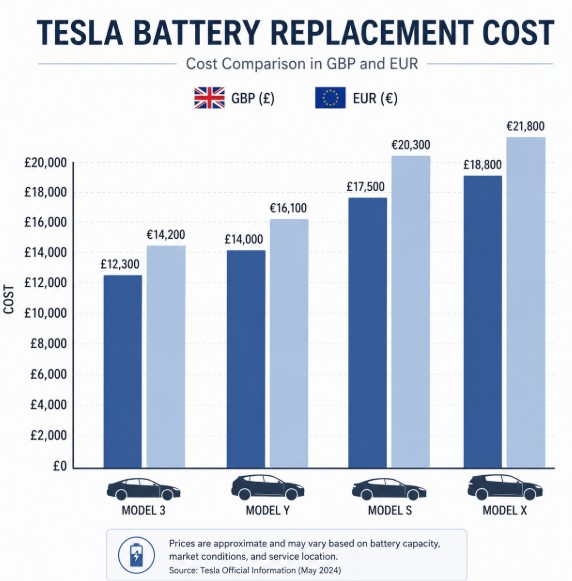
European and UK owners see a similar spread, adjusted for currency and local labor rates.
| Model | Estimated Cost (UK) | Estimated Cost (EU, approx.) |
| Model 3 | £8,000 – £12,000 | €9,000 – €14,000 |
| Model Y | £10,000 – £14,000 | €11,500 – €16,000 |
| Model S | £13,000 – £20,000 | €15,000 – €23,000 |
| Model X | £13,000 – £20,000 | €15,000 – €23,000 |
A few things push European pricing around. Battery chemistry, for one: Standard Range Model 3 and Model Y cars built for Europe increasingly run lithium iron phosphate (LFP) cells, which cost less per kWh than the nickel-based chemistry in Long Range models.
Will Tesla replace my battery for free?
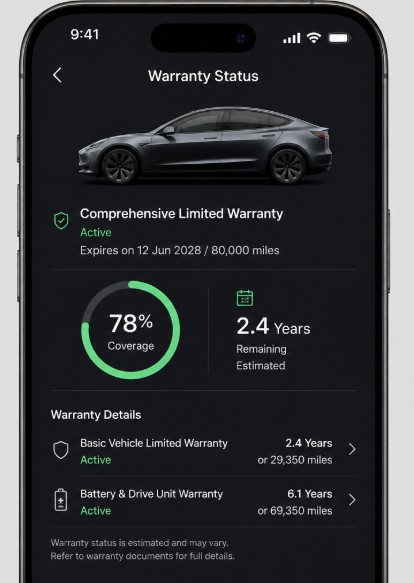
Yes, if your car is still within its Battery and Drive Unit Limited Warranty period. Tesla replaces a pack at no cost if it drops below the guaranteed capacity threshold (typically 70%) before the warranty runs out, or if it fails from a manufacturing defect.
Outside that window, you’re paying full price unless one of these applies:
- The failure traces back to a known recall or defect campaign
- You bought Tesla’s Extended Service Agreement (where it’s available)
- Tesla issues a goodwill repair, which happens sometimes but isn’t guaranteed
If you’re not sure whether your car is still covered, check the Tesla app under Service > Vehicle Details. Worth doing before you pay for a diagnostic that a warranty claim would’ve covered anyway.
Battery and Drive Unit Limited Warranty
How long is a Tesla battery guaranteed for?
Tesla’s warranty terms differ by model:
- Model 3 (Standard Range RWD): 8 years or 100,000 miles, whichever comes first, minimum 70% capacity retention
- Model 3 (Long Range/Performance) and Model Y: 8 years or 120,000 miles, minimum 70% retention
- Model S and Model X: 8 years or 150,000 miles, minimum 70% retention
Whichever comes first, years or mileage, ends the warranty. A high-mileage rideshare Model 3 could hit its mileage cap well before the 8-year mark. A low-mileage commuter car might age out of warranty with plenty of miles still on the clock. This warranty also transfers to a new owner if you sell the car. Worth remembering if you’re shopping used: the remaining coverage is part of what you’re actually buying.
How many years will a Tesla battery last?
Here’s the part that should actually calm you down. Tesla batteries are generally lasting 10 to 20 years, often 300,000 to 500,000 miles, before degradation gets bad enough to affect daily driving. Real-world fleet data, including Tesla’s own reporting and third-party tracking from rideshare and taxi fleets, shows most packs holding onto roughly 85 to 90% of original capacity even after 150,000 to 200,000 miles. A full battery failure that requires a total swap is rare. What’s typical is a slow, small loss of range every year.
real-world battery degradation data
Signs your battery might need attention:
- A noticeably shorter range than when the car was new, beyond normal seasonal swings
- Charging errors, or the car refusing to charge past a certain percentage
- Warning messages in the Tesla app about battery health
- Unusual noises or a burning smell (rare, but get to service immediately if this happens)
A gradual 10 to 15% range drop over many years is just normal aging. A sudden, sharp drop is your cue to book a diagnostic.
Can I extend my Tesla Model S battery life?
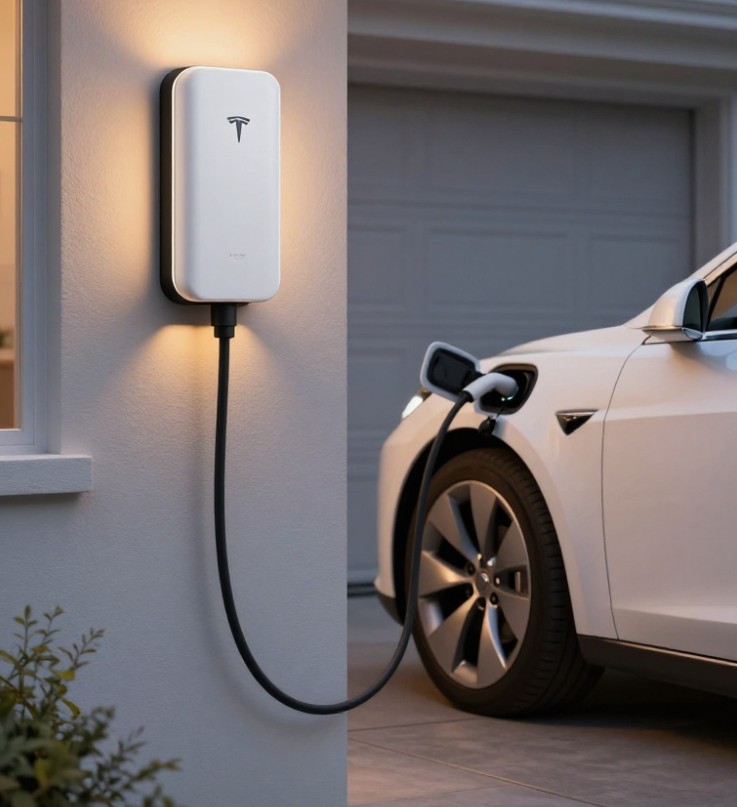
Yes. And the habits that help are the same ones Tesla recommends across its lineup. The Model S just rewards them more, thanks to its bigger, higher-capacity pack.
What actually helps:
- Charge to 80 to 90% for daily driving. Save 100% charges for road trips. Charging to full constantly stresses the cells more than partial charging does.
- Don’t let the battery sit near empty for long stretches. Try to stay above 10 to 15% state of charge as a habit.
- Go easy on Superchargers when you have home charging. Fast charging isn’t harmful occasionally, but leaning on it exclusively adds more heat cycling over time.
- Park out of extreme heat when you can. Heat is harder on lithium-ion cells than cold, though both wear the pack down at the edges.
- Keep your firmware updated. Tesla rolls battery management improvements into standard updates, and they can change how the pack charges and balances.
- Check your rated range in the app every few months. It gives you an early read on your car’s specific degradation trend instead of leaning on general averages.
Buying a Used Tesla for Sale? Check This Before You Pay
Tesla Price in USA vs Europe: What Every Model Actually Costs in 2026
Pentagon Big Tech Tesla Cybertruck : Here’s What’s Actually Happening
Does Tesla charge for battery replacement under warranty?
No. If your battery fails or drops below the guaranteed capacity threshold during the warranty period, Tesla replaces it for free.
Is it cheaper to replace a Tesla battery with a refurbished pack?
Usually. Refurbished packs from independent specialists can run 30 to 50% less than a new OEM pack, though they typically carry a shorter warranty (1 to 3 years).
Do all Tesla models have the same battery warranty?
No. Model 3 Standard Range gets 8 years/100,000 miles. Long Range Model 3 and Model Y get 8 years/120,000 miles. Model S and Model X get 8 years/150,000 miles. All with a 70% minimum capacity guarantee.
Does the battery warranty transfer to a used Tesla?
Yes. The remaining warranty passes to the next owner, which is worth factoring into the price when you’re buying used.
How much range does a Tesla battery lose per year?
For most owners, it’s a small, gradual decline, often just a few percentage points a year. Many packs still hold 85% or more of their original capacity past 150,000 miles.