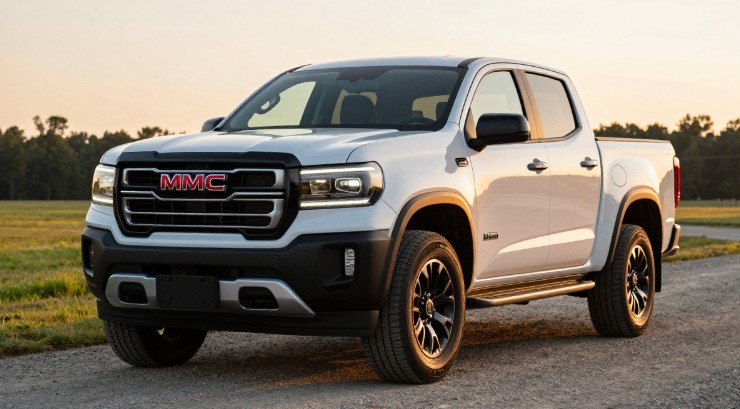
GMC Canyon Review 2026: The Ultimate Guide to Price, Spec
1. GMC Canyon overview
The GMC Canyon is a midsize pickup built by General Motors. It shares its platform with the Chevrolet Colorado.
GM redesigned the Canyon for 2023. That’s when it dropped the smaller four-cylinder options and settled on one turbocharged engine family. The move pushed the truck upmarket, more premium, more off-road-ready than the midsize trucks that came before it. You’ll find it across the US and Canada. GM also ships it through international channels into parts of Europe and the Middle East, for buyers who want an American truck with a little more attitude than the segment usually offers.
Table of Contents
2. GMC Canyon price
Pricing starts in the low-to-mid $30,000s for the entry Elevation trim. A loaded Denali or AT4X will push past $50,000. Trim Positioning Elevation Value-focused, sporty blacked-out styling AT4 Off-road oriented, all-terrain focus AT4X Top off-road trim, factory-tuned suspension Denali Luxury-focused, most refined interior.
Here’s the 2026 GMC Canyon pricing by trim and drivetrain, based on current MSRP data:
| Trim | Drivetrain | MSRP |
|---|---|---|
| Elevation | 2WD (RWD) | $38,900 |
| Elevation | 4WD | $42,200 |
| AT4 | 4WD (standard) | $45,500 |
| Denali | 4WD (standard) | $53,300 |
| AT4X | 4WD (standard) | $57,300 |
Prices shift by region, dealer incentives, and import taxes. European buyers especially should watch for VAT and emissions surcharges. They add up fast.
Build & Price your 2026 GMC Canyon
3. GMC Canyon engine and performance
Every current GMC Canyon runs a 2.7-liter turbocharged four-cylinder, tuned two ways. The standard version gives you plenty of low-end torque for daily driving and light towing. The high-output version, standard on AT4X and Denali, gets closer to 310 horsepower and over 400 lb-ft of torque.
Power goes through an 8-speed automatic to rear-wheel drive or four-wheel drive, depending on trim.
4. GMC Canyon MPG and fuel economy
Expect 16 to 19 mpg city and 18 to 21 mpg highway, depending on trim, drivetrain, and tire size. The AT4X sits at the low end, thanks to its larger off-road tires and 4WD hardware. Rear-wheel-drive Elevation models do better.
These numbers hold up fine for a turbocharged four-cylinder truck this size. But if you’re coming out of a sedan, you’ll feel the difference at the pump.
5. Towing capacity
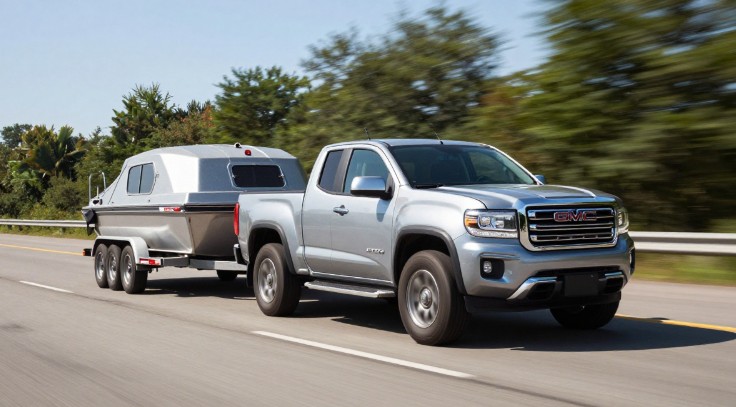
Towing is where the Canyon earns its keep. Properly equipped, it tows up to roughly 7,700 lbs, ahead of several midsize rivals.
That’s enough for a boat, a small camper, or a utility trailer, without stepping up to a full-size truck. Actual capacity depends on trim, axle ratio, and the tow package you pick, so confirm your exact build before you assume the max number applies to you.
6. Payload capacity
Payload, the combined weight your truck can carry in the bed and cabin, runs from about 1,100 to 1,600 lbs across the lineup.
Work-oriented trims with stiffer suspension carry more. Off-road trims like the AT4X give some of that up in exchange for suspension travel and ground clearance.
7. Interior and comfort
The cabin feels more upscale than older midsize trucks, especially in Denali trim. Leather seating, extra sound insulation, softer materials throughout.
Elevation and AT4 lean rugged instead, with cloth or vinyl-blend upholstery built to shrug off mud and gear. Rear seat space is decent for the class, though taller adults might find rear legroom a bit tight compared to a full-size truck.
8. Technology and infotainment
Every Canyon comes with a large touchscreen, 11 to 17 inches depending on trim, plus wireless Apple CarPlay and Android Auto and a configurable digital driver display. Higher trims add a premium audio system, a bigger head-up display, and more USB-C ports.
The tech feels current. It skips the dated, bolted-on feel that hurt older midsize trucks.
9. Safety features
Standard driver-assistance kit includes forward collision alert, automatic emergency braking, lane keep assist, and a following distance indicator. Higher trims add adaptive cruise control, a surround-view camera, and rear cross-traffic alert.
Check the current model year’s crash-test ratings from NHTSA in the US or Euro NCAP in Europe before you buy. Standard equipment and ratings shift year to year.
10. Off-road capability
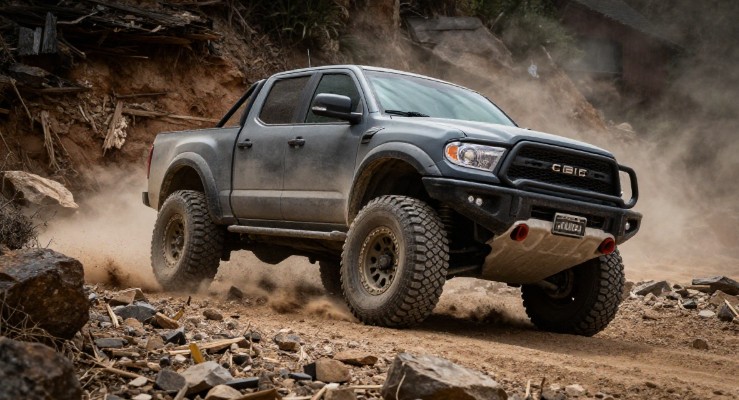
This is where the Canyon separates itself. AT4 and AT4X trims add two-speed transfer cases, a locking rear differential, underbody skid plates, and all-terrain or off-road tires.
Ground clearance and approach and departure angles lead the class on these trims. If you actually plan to leave the pavement, not just look like you might, the Canyon backs it up.
11. AT4: features and performance
AT4 is the Canyon’s off-road specialist below the AT4X. It gets a 2-inch factory lift, all-terrain tires, a locking rear differential, hill descent control, and dedicated off-road drive modes.
It splits the difference between capability and daily usability. More rugged than Elevation, but it skips the AT4X’s heavier hardware, the off-road-tuned dampers and wider track that push the price up.
12. GMC Canyon Denali: luxury features
Denali drops the off-road talk and focuses on comfort. Standard leather, heated and ventilated front seats, a heated steering wheel, unique chrome and badging, and the most complete tech package GM offers on this truck.
It’s built for buyers who want the capability of a truck without giving up the comfort of a luxury SUV. Think of it as GMC’s answer for Canyon buyers who rarely go off-road.
13. Dimensions and bed size
The Canyon runs roughly 212 to 213 inches long, with a bed around 61 inches, just over 5 feet, on crew cab builds. Width lands around 74 to 90 inches depending on whether you count the mirrors.
Ground clearance ranges from about 8.4 inches on standard trims up to nearly 10.7 inches on the AT4X. It sits firmly in the midsize category: smaller than a Silverado, bigger than the compact trucks of a decade ago.
14. Driving experience
On the road, the Canyon feels planted. The turbo engine gives you strong low-end torque for merging and passing without much drama.
Ride quality changes by trim. Elevation and Denali stay smoother and more compliant. AT4X rides a bit firmer on pavement, a fair trade for the extra articulation it gives you off-road. Steering feels well-weighted, and cabin noise stays under control for a truck this size.
15. GMC Canyon vs Ford Ranger
The GMC Canyon generally tows more and packs a stronger base engine than the Ford Ranger. The Ranger counters with a more efficient hybrid option in some markets (the PHEV, sold in Australia and Europe) and a lower starting price on certain trims.
Category GMC Canyon Ford Ranger Base engine 2.7L Turbo I4 2.3L or 2.0L Turbo (region-dependent) Max towing ~7,700 lbs ~7,500 lbs (varies by market) Off-road trim AT4X Raptor Interior tech Larger standard screens Competitive, SYNC-based
Both trucks earn their price tags. The decision usually comes down to dealer availability near you, whether you prefer the AT4X or the Raptor for off-roading, and regional pricing.
16. GMC Canyon vs Toyota Tacoma
Quick answer: the GMC Canyon typically beats the Toyota Tacoma on horsepower and towing. The Tacoma holds a stronger reputation for reliability and resale value over time.
Category GMC Canyon Toyota Tacoma Horsepower (top trim) ~310 hp ~326 hp (i-FORCE MAX hybrid) Towing capacity ~7,700 lbs ~6,500-6,000 lbs (trim-dependent) Off-road trim AT4X TRD Pro Reliability reputation Solid Historically excellent
If resale value and long-term reliability history matter most to you, the Tacoma has the edge. If you care more about raw towing power and interior tech, the Canyon pulls ahead.
17. Pros and cons
Pros:
- Strong towing capacity for a midsize truck
- A genuinely capable AT4X off-road trim
- Modern, spacious interior tech
- A powerful standard engine lineup
Cons:
- Fuel economy trails some four-cylinder rivals
- Ride gets firm on the off-road-tuned trims
- Pricing climbs fast on higher trims
- Only one engine choice, no V6, no diesel
18. Maintenance and ownership costs
Routine maintenance costs line up with other domestic midsize trucks. Oil changes, tire rotations, brake service, all affordable and easy to find at GMC dealerships across the US.
If you own an AT4X and plan to actually off-road it, extended warranty coverage is worth a look. Suspension parts see more wear out there. European owners should plan for higher parts costs and longer waits, since GMC’s dealer network is thinner outside North America.
19. Is the GMC Canyon a good truck to buy?
Yes. It’s a strong pick if you want real towing muscle, genuine off-road capability, and modern tech in a midsize package. If fuel economy or long-term reliability reputation tops your list, cross-shop the Tacoma first.
It fits people who tow trailers, boats, or campers often. It fits families who want SUV-like comfort in a Denali. It fits off-road enthusiasts drawn to the AT4X. It fits less well if your main concern is maximum fuel efficiency or the lowest possible ownership cost.
GMC Hummer EV Torque Explained: What 11,500 lb-ft Actually Means
Lucid Gravity Review 2026: Is This Electric SUV Worth $81,750?
Is the GMC Canyon the same as the Chevrolet Colorado?
They share the platform, the engine, and most of the underlying architecture. But the Canyon carries its own styling, its own trim names, and a more premium feel, especially in Denali guise.
How much can a GMC Canyon tow?
Properly equipped, up to roughly 7,700 lbs, depending on trim and configuration.
What is the best engine in the GMC Canyon?
The high-output 2.7L turbo four-cylinder, standard on AT4X and Denali. It’s the strongest option, at roughly 310 hp and 430 lb-ft of torque.
Is the GMC Canyon AT4X worth the extra cost?
If you actually off-road, yes. The suspension, tires, and drivetrain hardware are real upgrades, not just badges and paint.
Is the GMC Canyon available in Europe?
In limited markets, through specialty importers and GM’s international channels. Official dealer support and parts availability stay more limited than in North America.