
Chinese Satellite Pulverizes Starlink: What the 2-Watt Laser Test Really Proved
In June 2025, Chinese researchers downlinked data from a satellite parked in geostationary orbit, 36,000 kilometers above Earth. They used a laser so weak people keep comparing it to a candle flame. Still, they hit 1 gigabit per second. That’s roughly five times faster than Starlink’s typical real-world speedsa Chinese team fired a laser no brighter than a candle from geostationary orbit and moved a gigabit of data per second, about five times what Starlink typically delivers, proving low-power optical links can beat conventional approaches.
Table of Contents
What does “Chinese satellite pulverizes Starlink” actually mean?
Short answer: it’s a headline about a speed record. Not a weapon.
A Chinese team used a low-power laser to send data from a satellite 36,000 km away, faster than Starlink’s typical connection. Nothing got destroyed, disabled, or attacked.
Professor Wu Jian of Peking University and Dr. Liu Chao of the Chinese Academy of Sciences led the research Prof. Wu Jian of Peking University and Dr. Liu Chao of the Chinese Academy of Sciences down-linked 1 Gbps from an unnamed GEO satellite 36,705 km above Earth using a 2-watt laser.
How the Chinese laser satellite achieved 1 Gbps
The core technology: AO-MDR
The breakthrough comes down to a method called AO-MDR. It combines adaptive optics (AO) with mode diversity reception (MDR)researchers around the world had tried adaptive optics to sharpen distorted light, or mode diversity reception to capture scattered signals, but neither worked alone under strong turbulence.
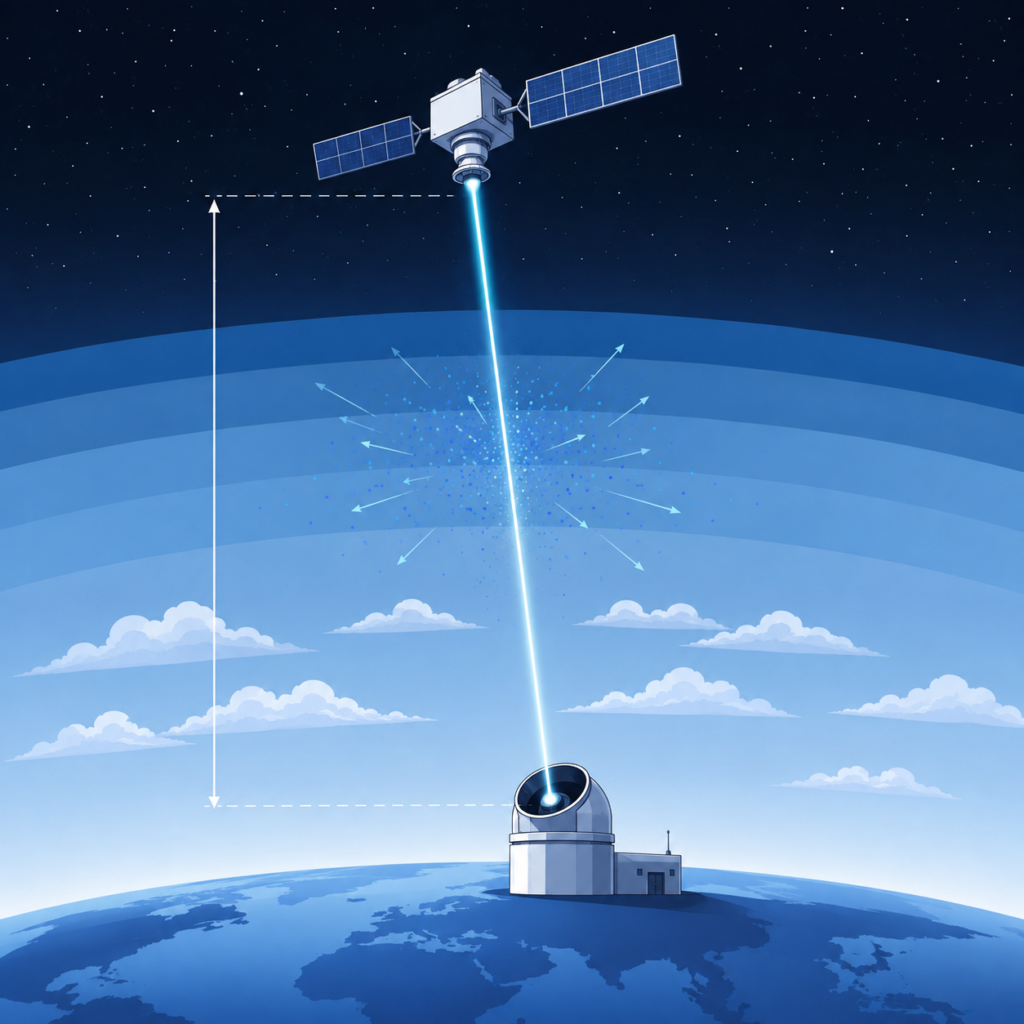
Here’s the problem they solved. A laser signal traveling 36,000 km through Earth’s atmosphere gets scattered and warped before it hits the ground satellite laser downlinks are fast, but atmospheric turbulence scatters the light into weak, fuzzy patches hundreds of meters wide by the time it reaches the ground.
Instead of trying to rebuild a clean signal, the Chinese team took a different route:
- They used 357 micro-mirrors on a 1.8-meter telescope to reshape the incoming wave front the AO-MDR method combines 357 micro-mirrors on a 1.8 m telescope with eight spatial modes, plus a path-picking algorithm that selects the three cleanest channels.
- They didn’t fix the whole distorted beam. They found which fragments survived the trip intact and stitched those together.
- That pushed usable signal from 72% to over 91%, even under heavy turbulence usable signal rose from 72 percent to 91.1 percent.
End result: a 2-watt laser (weaker than a typical LED bulb) delivered a stable 1 Gbps connection from one of the farthest practical orbits you can communicate from.
China has also demonstrated advances in high-speed satellite-to-ground laser communication, including a reported 120 Gbps transmission experiment using a laser communication system developed by the Chinese Academy of Sciences.
Where the test happened
Researchers captured the downlink at Lijiang Observatory in southwestern Chinaat Lijiang Observatory in southwestern China, a laser signal descended from a satellite parked 36,000 kilometers above Earth. They picked the spot for its clear, high-altitude skies. And that’s still a condition the test depended on.
Why comparing this to Starlink is misleading
Most headlines skip this part. It’s the piece you actually need.
| Factor | Chinese GEO laser system | Starlink |
| Orbit altitude | ~36,700 km (geostationary) | ~550 km (low Earth orbit) |
| Purpose | Single high-speed downlink demo | Serve millions of users at once |
| Signal type | Laser (optical) | Radio frequency |
| Real-world speed | 1 Gbps (single test) | 100-300 Mbps typical, up to ~600 Mbps peak |
| Coverage | One fixed point | Global, moving constellation |
Starlink’s satellites sit far closer to Earth, built to serve huge numbers of home terminals simultaneously Starlink operates from low Earth orbit, a few hundred kilometers up, using radio antennas to serve individual homes. The Chinese system sent one point-to-point signal across a distance roughly 60 times longer the Chinese GEO demo delivered 1 Gbps, about five times Starlink’s typical throughput from 550 km altitude, with the GEO path about 60 times longer. Different orbit, different job, different engineering problem entirely
The real story here is power efficiency, not raw speed. Pulling a usable gigabit signal out of a candle-strength laser across that distance, that’s the achievement analysts say the real takeaway is power-per-bit from GEO, not raw speed, especially given Starlink’s own 100 Gbps cross-links and Chinese startups’ 400 Gbps inter-satellite tests.
Why this story matters beyond the headline
1. It’s part of a bigger space race
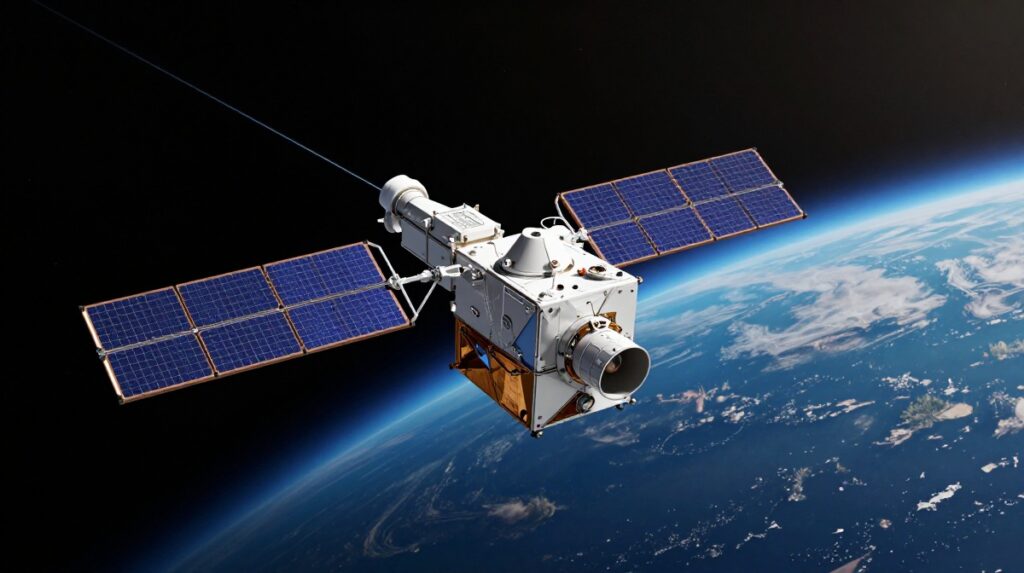
China isn’t just experimenting with lasers. It’s building its own satellite internet rivals to Starlink.
Reuters reported plans for roughly 43,000 low-Earth-orbit satellites across two programs, Qianfan (SpaceSail) and Guowang Reuters reports China plans 43,000 LEO satellites across the Qianfan (SpaceSail) and Guowang programs to occupy orbital slots and challenge Starlink in the Global South. Part of the goal: compete with Starlink across the Global South.
2. There’s a military angle, and it’s a separate story
Chinese military-linked journals have flagged Starlink as a strategic concern, especially since it played a real role in Ukrainian battlefield communications after Russia’s 2022 invasion satellite constellation vulnerabilities drew more attention after Russia’s 2022 invasion of Ukraine, where Starlink helped soldiers coordinate actions and direct drones.
Separate research papers, unrelated to this laser test, have floated ideas from anti-satellite lasers to microwave “soft-kill” systems aimed at disabling Starlink satellites one academic paper suggested using lasers and microwaves to shoot down Starlink satellites, arguing high-power microwaves or laser weapons could cause soft damage to the communications satellites.
Keep that separate from the June 2025 speed demo. One’s a civilian communications result. The other’s a military policy debate. Blending the two is exactly where the “pulverizes” framing goes wrong.
3. Optical communication could reshape future satellite networks
Chinese military journals frame laser links as hard to intercept, which makes them attractive for secure communication and, potentially, future directed-energy work Chinese military journals frame optical links as low-probability-of-intercept communications and a stepping stone to directed-energy weapons. That’s a real trend, and it’s bigger than any single benchmark test.
What this means for US Starlink users
If you’re a Starlink subscriber in the US, none of this touches your service today. No consumer product exists. No live network. Nothing suggests this tech is headed toward American households soon.
What it does signal:
- More competition is coming. China’s planned constellations (Qianfan, Guowang) pose a much bigger long-term challenge to Starlink than any single laser test.
- Optical links will probably spread industry-wide. Starlink already runs laser cross-links between its own satellites at far higher speeds, up to 100 Gbps analysts note Starlink’s own 100 Gbps cross-links alongside Chinese startups’ 400 Gbps inter-satellite tests. This race runs both directions.
- The geopolitical tension around satellite networks is real, especially given Starlink’s dual civilian-military role.
The headline grabs you. The real story is an engineering achievement: a stable 1 Gbps signal pushed through atmospheric turbulence, using a laser weaker than a household light bulb, across a distance five times farther than Starlink’s operating altitude.
It’s one meaningful step in optical satellite communication, and one piece of a much bigger, ongoing rivalry between China and the US over space and satellite internet.
Want the bigger picture? Compare this against how Starlink’s own laser cross-links work. That’s where the real technology race is happening.
More on EV :
Skyroot Vikram-1 Launch: Inside India’s First Private Orbital Rocket
What Is Regenerative Braking? Tesla’s One-Pedal System Explained
Best EV Car Gadgets in 2026: 10 Must-Have Accessories Every Electric Vehicle Owner Needs
Hummer EV Torque Explained: What 11,500 lb-ft Actually Means